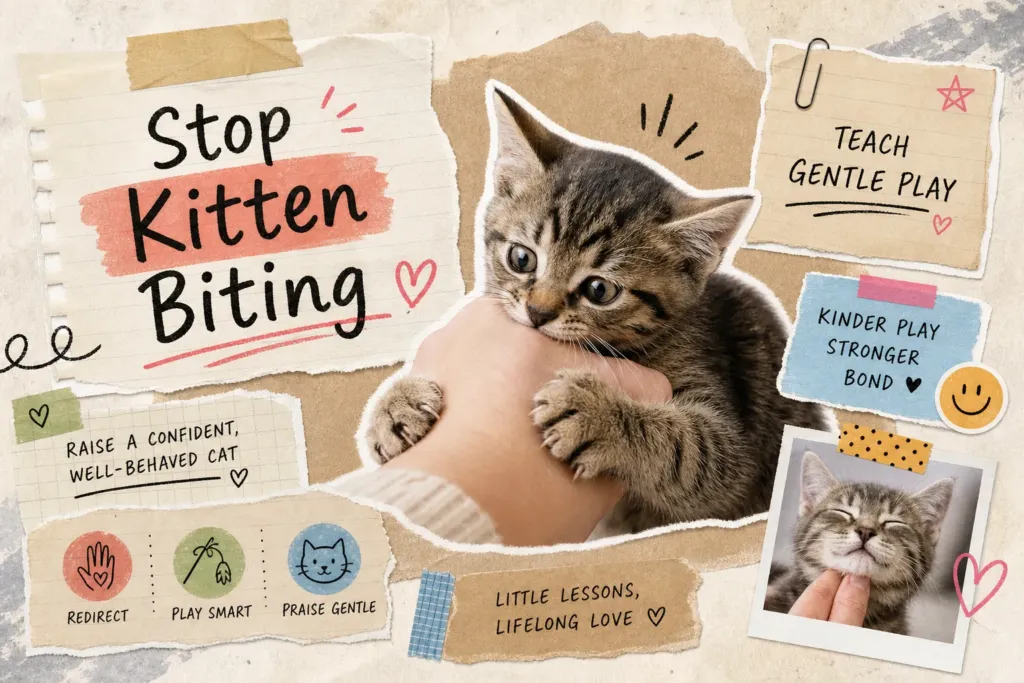
You reach down to pet your new kitten, and those tiny needle-sharp teeth clamp right onto your finger. It happens so fast you are not even sure what set it off. If this sounds familiar, you are dealing with one of the most common complaints among new kitten owners, and the good news is that it is almost always a normal, trainable behavior rather than a sign that something is wrong with your cat. Learning how to stop a kitten from biting is more straightforward than most people expect, especially when you understand what is driving it.
What makes the difference is having a clear, prioritized plan rather than a handful of random tips tried on random days. The 9 steps below work as a connected sequence, complete with specific toy picks, an honest training timeline, and clear signals for when biting has crossed into medical or behavioral territory that needs professional attention. One detail worth noting upfront: research consistently shows that kittens who receive thorough early handling and socialization from ethical breeders often arrive with calmer baseline temperaments, which gives training a genuine head start. Starting from a good foundation matters.
Why kittens bite and when it tends to peak
There are four main reasons kittens bite: teething, play and hunting instinct, overstimulation, and fear or stress. Knowing which trigger you are dealing with matters because the fix is slightly different for each one. A kitten biting because its gums hurt needs a different approach than a kitten biting because it has been petted past its comfort threshold.
Biting is most intense from roughly 2 to 7 months of age. Most kittens become noticeably gentler around 5 to 7 months as teething winds down and impulse control develops. Play biting is usually loose and energetic, happening in the middle of an excited chase or pounce. Defensive biting is more abrupt and comes paired with warning signals like a stiff body, a flicking tail, or ears rotating backward. Learning to tell these two apart before you start training will save considerable frustration.
Teething and sore gums: the 3, 7 month window
Kittens replace their baby teeth with adult teeth between roughly 3 and 7 months, and the gum discomfort that comes with it drives a real increase in chewing and biting. This is why some owners notice the behavior suddenly ramping up around 3 to 4 months even if things seemed fine before. Teething biting tends to target harder objects and anything nearby, including your hands, because pressure on sore gums brings relief. It differs from play biting in that the kitten is seeking the sensation of chewing rather than acting out a hunting sequence.
Play drive and the hunting instinct
Kittens are hardwired to stalk, pounce, and bite as part of learning predatory skills. Social play peaks around 9 to 16 weeks, and object play peaks around 4 to 6 months, so there is a predictable window when biting intensity is highest. The timing is not random; it maps directly onto normal feline development. Kittens allowed to play-bite hands during those early weeks often carry that fully learned habit into adulthood, which is why the foundation steps in this plan focus on getting the rules right from the very first day.
Overstimulation and fear: the less obvious triggers
Overstimulation biting happens when a kitten has been petted too long, handled too roughly, or pushed past its comfort threshold during an intense play session. The bite can feel unprovoked, but the kitten was signaling discomfort for several seconds beforehand. Fear biting is different: a scared kitten bites to make an interaction stop, not out of aggression or playfulness. Early warning signs include a tail that starts swishing, skin rippling along the back, or ears rotating backward. Stopping at those signals prevents the bite entirely rather than requiring a correction after the fact.
How to stop kitten from biting: steps 1, 3 (breaking the habit before it gets ingrained)
These three steps work as a single sequence and need to happen from day one. Remove the wrong target, deliver a calm clear signal, then redirect to the right target. The sequence only works when executed every single time, even when the kitten is being adorable about it. Punishment, flicking the nose, or yelling backfires because it either frightens the kitten or accidentally rewards the behavior with high-energy attention.
Step 1: Never let hands or feet become toys
Kittens taught to chase fingers or toes literally learn that body parts are valid prey targets, and that lesson sticks. Switch all interactive play to wand toys, kicker toys, or balls immediately, not gradually. This removes one of the biggest sources of rehearsed biting behavior, because a kitten cannot practice biting hands if hands are never part of the game. If your kitten ambushes your feet under a blanket, redirect immediately by sliding a kicker toy or trailing a wand along the floor rather than pulling your foot away and repeating the chase dynamic.
Step 2: The “ouch” cue and immediate attention withdrawal
When the kitten’s teeth make contact with skin, say “ouch” in a calm, clear voice, go completely still, and withdraw attention for a short period, around 15 to 30 seconds, by standing up or turning away. Biting ends the fun, which is the opposite of what the kitten wants. Consistency is everything here. If you sometimes laugh, sometimes react strongly, and sometimes use the ouch cue, the mixed signals slow the learning process significantly. One calm, identical response every time is what teaches the lesson.
Step 3: Redirect to a toy within seconds
As soon as the kitten aims for your skin, put an appropriate toy in front of them and let play continue on that target. Redirection gives the predatory drive an acceptable outlet rather than suppressing it, which is why it works so much better than punishment. Timing is critical, a long pause between the nip and the toy offer breaks the connection the kitten needs to make between the behavior and the consequence.
Steps 4, 6: Building a routine that makes gentle play the default
The first three steps respond to biting after it starts. These next three restructure the kitten’s day so biting is less likely to happen in the first place. Think of it as reducing the pressure in the system rather than just relieving it when it blows. This is a multi-week commitment, and household consistency is the single biggest factor in how quickly it works.
Step 4: Schedule active play sessions every day
Aim for two to three short play sessions of 10 to 15 minutes each, using prey-like movement to fully engage the hunting drive. A wand toy that mimics a bird or mouse in motion is far more satisfying than a stationary toy, and a satisfied hunter is a calmer cat. Vigorous play before bedtime is especially useful for reducing late-night zoomies and nipping. Try ending each session with a small meal or treat to follow the natural hunt-eat-groom-rest pattern, which helps the kitten wind down rather than ramping back up.
Step 5: Reward gentle behavior actively
Give the kitten clear feedback on what earns attention, not just what stops it. When the kitten mouths softly, chooses the toy over your hand, or sits calmly in your lap during a non-play moment, mark that with a treat, quiet praise, or continued interaction. Rewarding calm handling during everyday moments speeds up overall temperament development in a way that reactive corrections alone never will.
Step 6: Get everyone in the household using the same rules
One person who still lets the kitten bite fingers undoes every bit of progress everyone else makes. Have a brief conversation with all household members, including children and frequent guests, about the exact cue and redirect sequence. Inconsistency is the number one reason training stalls, and it is entirely preventable with a five-minute conversation up front.
Steps 7, 9: Advanced techniques for lasting bite inhibition
These steps build on the foundation from steps 1 through 6. They focus on teaching the kitten to tolerate handling, reading overstimulation signals before a bite happens, and using the right toy rotation to keep redirecting effective over months of training. Together, they are what move a kitten from “less bite-y than before” to genuinely gentle with people.
Step 7: Teach the kitten to tolerate handling without nipping
Start only when the kitten is already relaxed and calm, never during high-energy play. Begin with light touch, then gradually add paws, ears, the mouth area, and brief lifts across several short daily sessions. Pair every calm moment with a quiet treat or soft praise. This is separate from play time and should be treated as its own short, intentional practice window rather than something you fit in while the kitten is already zooming around.
Step 8: Read overstimulation cues and stop before the bite
Watch for a tail that starts flicking or thumping, skin rippling along the back, ears rotating backward, and pupils dilating during a petting session. These are your warning lights. Stopping at the first signal and letting the kitten settle prevents the bite entirely rather than requiring a correction afterward. Over time, consistently respecting those signals builds a calmer cat that genuinely trusts being handled, and one that bites less because it no longer feels the need to escalate.
Step 9: Choose the right toys and rotate them regularly, a key part of how to stop kitten nipping
Three toy categories cover the most ground for redirecting nipping. Wand toys like the Go Cat Da Bird Feather Teaser or Cat Dancer Rainbow Cat Charmer are well-regarded for interactive redirecting because they mimic prey movement and keep teeth away from hands. Kicker toys like the Yeowww Catnip Banana satisfy the urge to grab, bite, and bunny-kick without involving your hands at all. Puzzle feeders provide mental engagement during lower-activity periods and help reduce boredom-driven nipping. Rotate three to four toys every couple of days to keep them novel rather than leaving everything out permanently.
A practical session might look like this: let the kitten stalk, chase, catch, and bite the toy. If teeth hit skin, pause, then re-offer the toy. End with a small treat to close the hunting sequence naturally, this helps the kitten settle rather than immediately looking for the next target.
What to expect: a realistic training timeline
Most kittens show noticeable improvement within two to three weeks when everyone in the household responds consistently. “Noticeable improvement” means less frequent and less intense biting, not a complete stop, an important distinction that keeps owners from giving up too early.
Early progress in the first few weeks
The first two to three weeks are about building the habit on your end: same cue, same redirect, every single time. This phase can feel slow because you are responding to biting more than preventing it. Keep going. Kittens who arrived already comfortable with human contact, thanks to thorough early handling, often respond faster in this phase because the handling itself is already familiar. If you are still choosing a kitten, asking a breeder about their early socialization practices is a reasonable question worth raising.
Milestones at 5, 7 months and beyond
Biting is often strongest from 2 to 7 months and typically drops significantly as teething ends around 6 to 7 months. Most cats are much gentler by 8 to 12 months, though learned habits from months of hand-play take longer to undo than natural teething-driven biting. Starting these kitten behavior tips early is not just helpful; it is what determines whether you are correcting a habit or simply waiting for it to mature away on its own.
When biting is not just a kitten phase
Most kitten biting is normal and trainable, but some biting signals a medical or behavioral problem that needs professional attention. Knowing the red flags keeps you from applying training solutions to a health problem, which wastes time and leaves the underlying issue unaddressed.
Medical red flags to take seriously
- A sudden change in biting intensity or personality in a previously gentle kitten
- Biting paired with flinching when a specific area is touched, hiding, or refusal to be petted
- Signs of dental pain: drooling, bad breath, bleeding gums, or refusal to eat hard food
- Biting that starts after an injury or fight, especially if there is swelling or worsening pain
- Any biting paired with lethargy, vomiting, limping, or other illness signs
Behavioral red flags that need a professional
- Unprovoked or unpredictable aggression toward people or other pets
- Frequent bites that break skin and are hard to redirect even with consistent training
- Biting paired with hissing, growling, flat ears, dilated pupils, or raised hackles
- Excessive self-biting of paws or tail, which can point to pain, parasites, or a neurological issue
The practical rule is straightforward: if biting is new, escalating, painful-looking, or paired with any other symptom, treat it as a health or behavior problem rather than a training problem. See your vet first. If the vet rules out physical causes and biting is still frequent or linked to fear and stress, a certified cat behaviorist is the right next step.
How to stop kitten from biting for good: stick with the plan
Teaching a kitten to play gently comes down to two things: understanding why the biting is happening and applying the 9 steps consistently over weeks and months. The first three steps interrupt the wrong behavior in the moment. The next three replace it with a calmer daily routine. The final three build lasting tolerance and bite inhibition that holds even when the kitten is excited or overstimulated.
For most kittens, you will see real reduction by 5 to 7 months and near-resolution by 12 months. Kittens at Kitty Palace Cattery benefit from early socialization practices that support this kind of progress, if you are still in the process of choosing a kitten, that early handling history is worth asking about wherever you look.
Kitten nipping is one of the most fixable behaviors there is. Be patient, stay consistent, and know that the same curious, playful energy driving all those little bites will eventually channel itself into the kind of gentle, affectionate companionship you were hoping for when you brought your kitten home.
FAQ
Kittens bite for four main reasons: teething, play and hunting instinct, overstimulation, and fear or stress. Which trigger is at work changes the fix—teething biting seeks gum relief while play biting is part of a hunting sequence — and the article emphasizes identifying the cause before training. Biting is also most intense from roughly 2 to 7 months of age, so age-related development is a common factor.
Biting tends to peak between about 2 to 7 months and most kittens become noticeably gentler around 5 to 7 months as teething eases and impulse control develops. Social play peaks around 9 to 16 weeks and object play peaks around 4 to 6 months, which explains the predictable window for high biting intensity. Individual variation exists, but the article stresses that early handling and socialization give training a head start.
Play biting is usually loose and energetic, occurring during an excited chase or pounce, whereas defensive biting is abrupt and paired with warning signals. Look for a stiff body, a flicking tail, or ears rotating backward as signs the bite is defensive rather than playful. Noticing those signals ahead of time lets you prevent bites instead of correcting them after the fact.
Teething occurs roughly between 3 and 7 months and drives increased chewing because pressure on sore gums brings relief. For teething-related biting, redirect the behavior to appropriate hard chew toys and avoid reinforcing hand-biting so the kitten learns to target objects instead of your hands. The article notes that teething biting often targets harder objects and anything nearby, so timely redirection helps break the habit.
Watch for early warning signs—such as a tail that starts swishing, skin rippling along the back, or ears rotating backward—and stop petting or intense play before the kitten escalates. Overstimulation biting happens when a kitten is pushed past its comfort threshold, while fear biting aims to make an interaction stop; respecting those signals prevents bites entirely. The article emphasizes short, controlled handling and recognizing the kitten’s limits as key prevention tactics.
Seek professional help if biting is severe, persists well beyond the usual developmental window, causes injury, or appears linked to pain or sudden behavioral change. The article warns that while most kitten biting is normal and trainable, there are clear signals when it has crossed into medical or behavioral territory that needs professional attention. A vet can rule out pain-related causes and a behaviorist can design a targeted training plan.