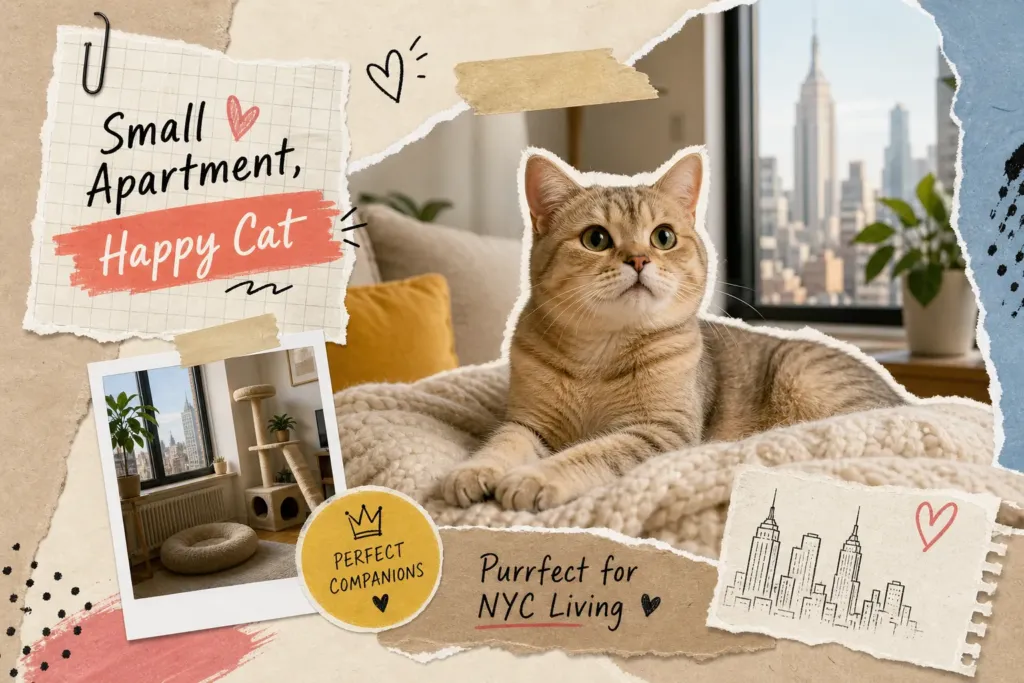
What is the best cat breed for a small apartment in New York? It’s one of the most common questions new cat owners in the city ask, and the answer matters more than most people realize. Coming home to a calm, affectionate cat after a long subway commute and a full day in a cramped office beats almost everything else. The problem is that many New Yorkers pick a breed based on looks alone and wind up with a high-energy, loud, or high-maintenance cat that’s miserable in 600 square feet, and makes the owner miserable right along with it.
This guide ranks the best cat breeds for small NYC apartments using four practical criteria: energy level, vocalization, grooming demands, and overall adaptability to indoor city living. You won’t find vague generalizations here. Each breed gets an honest assessment based on what life with that cat actually looks like in a studio or one-bedroom. Three of the top-ranked breeds, the British Shorthair, Scottish Fold, and Munchkin, are available from Kitty Palace Cattery, a TICA-registered cattery in New Jersey that delivers to New York.
What actually makes a cat breed apartment-friendly
Before jumping to the rankings, it’s worth understanding the logic behind them. Apartment-friendliness isn’t just about physical size. A lean, small cat with sky-high energy and a voice like a foghorn is a much harder fit for a Brooklyn studio than a stocky, quiet cat that’s happy to watch the world from a windowsill.
Energy level and daily exercise requirements
Low-to-moderate energy breeds thrive in apartments because they don’t build up the kind of restless drive that demands space to burn off. High-energy breeds like Bengals or Abyssinians are genuinely intelligent, active animals that can become destructive and anxious when they don’t have room to run and climb. Even the calmest apartment cat needs daily play, but the difference between a 15-minute wand toy session twice a day and an hour of intense activity is significant when you’re also managing a demanding city schedule.
Vocalization tendencies in thin-walled buildings
NYC apartment walls are notoriously thin, and your neighbors are close. A cat that yowls for attention, demands constant verbal responses, or vocalizes through the night is going to create friction fast. Siamese-type breeds are famously chatty, which is charming in a house and exhausting in a sixth-floor walk-up. British Shorthair and Scottish Fold cats rank at the quieter end of the spectrum, which is a genuine practical advantage in a dense building environment.
Grooming demands in a small living space
In a small apartment, cat hair gets everywhere faster than you’d expect. Low-to-moderate shedding breeds keep the daily cleanup more manageable, which matters when your living room is also your dining room and your bedroom. There’s also a useful distinction between grooming effort (how often you need to brush the cat) and shedding volume (how much fur floats around the apartment). A breed that needs weekly brushing but sheds moderately is a very different experience from one that requires daily grooming and still leaves fur on every surface.
What is the best cat breed for a small apartment in New York?
These breeds consistently perform well across all four criteria. The rankings reflect real temperament and practical daily life, not just general popularity, and each one has been assessed specifically for the demands of NYC apartment living.
British Shorthair: the gold standard for small-space living
The British Shorthair earns the top spot because it genuinely seems designed for the lifestyle of a busy New Yorker. It’s calm without being cold, affectionate without being needy, and quiet without being distant. This breed is perfectly content to spend long stretches of the day lounging on a perch while you’re at work, then settle beside you on the couch in the evening without demanding constant interaction. Its independence isn’t indifference; it’s just a well-matched temperament for owners who don’t want a cat that follows them into the bathroom.
Grooming is straightforward: a weekly brushing session handles most of the moderate shedding. Two short play sessions of 15 to 20 minutes daily satisfy its exercise needs without requiring elaborate setups. For first-time cat owners in New York, the British Shorthair is the lowest-risk, highest-reward choice on this list.
Scottish Fold and Scottish Straight: calm, quiet, and completely at home indoors
The Scottish Fold’s signature folded ears get all the attention, but what makes it a standout apartment cat is its temperament. These cats are genuinely relaxed, low-vocalization, and social without being demanding. They settle into routines naturally, adapt well to the rhythms of city life, and rarely make noise unless something is genuinely wrong. If your neighbors have already complained about a previous tenant’s dog, a Scottish Fold is about as considerate a cat as you can find.
The Scottish Straight is a close relative with identical temperament traits but without the folded ears. Both are strong apartment choices.
Munchkin: compact, playful, and more manageable than you’d expect
The Munchkin’s short legs are the first thing people notice, but its personality is what makes it work in a small apartment. It has moderate energy, more playful than a British Shorthair but far less demanding than an athletic breed. Its short-legged build also makes it less of a vertical threat in tight spaces; the Munchkin isn’t going to launch itself from the refrigerator to the top of your bookshelf. The breed is friendly and social, and many owners find it adapts comfortably to apartment routines, though individual temperament can vary, so meeting a kitten before committing is always a good idea.
Grooming depends on coat type, but most Munchkins have an easy-care coat that needs only occasional brushing. For owners who want a cat with genuine personality and a bit more interactive energy, without sacrificing apartment-friendliness, the Munchkin is worth a serious look.
Other solid picks worth considering
A few other breeds earn honorable mentions. The Persian has very low energy and is exceptionally quiet, but its long coat demands daily grooming that some owners underestimate. The Exotic Shorthair offers the same laid-back Persian temperament with a much easier short coat, a strong option for anyone who wants the Persian personality without the grooming commitment. The Russian Blue is quiet, independent, and sheds less than most breeds, making it a reasonable consideration for allergy-prone owners (though no breed is truly hypoallergenic). The Ragdoll is gentle and low-energy, though it runs large, which matters in a studio. These are all solid secondary options, but none match the combination of low maintenance, quiet temperament, and consistent availability that the top three offer.
NYC-specific realities that affect your choice
Breed research only gets you so far. The practical realities of New York living add wrinkles that most cat guides skip over entirely.
Building pet policies and lease rules in New York City
NYC buildings vary widely on pet policies. Some allow cats freely; others charge monthly pet rent or require a pet deposit. Some technically prohibit pets even when landlords informally tolerate them. The important thing to know is that New York City has a pet waiver rule: if a tenant openly keeps a pet and the landlord doesn’t start a proceeding within the required window after learning about it, the no-pet clause may be waived. That said, don’t rely on informal tolerance. Check your lease before bringing any cat home.
Co-op buildings typically have stricter rules than standard rentals, often requiring board approval for pets. Some buildings are cats-only, prohibiting dogs but welcoming cats. Pet deposits are subject to the state’s security deposit cap. Know your rights and know your building’s actual rules before you commit.
What a 400 to 700 square foot apartment actually means for a cat
The average NYC studio runs roughly 350 to 550 square feet, and a typical one-bedroom lands between 500 and 750 square feet. A cat doesn’t need a large floor plan. What it needs is vertical space, defined zones for sleeping and eating, and enough stimulation to stay mentally engaged. Even a compact studio works well for a calm breed when you add a window perch, a stable cat tree, and a consistent daily play routine. The breed matters far more than the square footage.
Setting up a small apartment to keep your cat happy
Choosing the right breed is the foundation. What you do with your space before the cat arrives matters nearly as much.
Making vertical space work harder than floor space
In a small apartment, vertical space is the most underused resource. A cat tree near a window, a wall-mounted shelf or two, and a stable perch at a comfortable height can effectively triple a cat’s usable territory without taking a single extra square foot of floor space. For lower-energy breeds like the British Shorthair, a wide, stable platform near a window is often enough to provide hours of entertainment. For more curious cats like the Munchkin, a multi-level structure with different textures and heights provides the mental stimulation they need. Wide, stable platforms matter more than height, especially for stockier breeds that aren’t natural high-jumpers.
Enrichment, litter placement, and daily routines that fit city living
Litter box placement is a real design challenge in a small apartment. Enclosed litter boxes and furniture-integrated solutions keep things discreet without sacrificing hygiene. In a studio, odor management is non-negotiable: daily scooping, a quality litter, and good airflow do most of the work. For play, two 10 to 15 minute sessions per day, morning and evening, satisfy even moderately active breeds and fit naturally into a city work schedule. Consistency matters more than duration: cats thrive on routine, and a predictable play and feeding schedule reduces stress in a busy urban environment.
Best cats for small apartments in NYC: where to find these breeds near New York City
Once you’ve landed on a breed, the sourcing decision is the most important call you’ll make. It affects the cat’s health, temperament, and your experience as an owner for the next 15 to 20 years.
Why where you get your cat matters as much as which breed you pick
High-demand breeds like British Shorthair and Scottish Fold attract a disproportionate share of online scams and unethical sellers. Photos of adorable kittens are easy to fake or steal; a reputable breeder with TICA registration is not. TICA registration means the cattery operates under a formal code of ethics, follows breed standards, and is accountable to an oversight body. Purebred rescues do exist, but availability for these specific breeds in New York is limited and unpredictable. You may wait a year or more for the right cat to come through. For buyers who want a specific breed with confidence in health and lineage, a registered breeder is the reliable path.
Kitty Palace Cattery: TICA-registered breeds delivered to New York
Kitty Palace Cattery is a TICA-registered, family-run cattery based in New Jersey that breeds British Shorthair, Scottish Fold, Scottish Straight, and Munchkin kittens. Kittens come with age-appropriate vaccinations and a health certificate.
For New York buyers who can’t easily make the trip to New Jersey, Kitty Palace Cattery offers delivery to the New York area, which removes a real logistical hurdle for city-based owners. If you know which breed you want, reaching out early to ask about upcoming litters is the right move. Check current availability and next steps through the Kitty Palace Cattery website.
The bottom line for NYC cat owners
If you’re still asking what is the best cat breed for a small apartment in New York, the honest answer is: the one that genuinely matches your lifestyle, your work hours, your noise tolerance, your grooming patience, and your energy level at the end of a long day. Choosing based on aesthetics alone is how people end up with a stressed, destructive cat and a frustrated owner. The rankings in this guide hold up because they’re based on temperament, not trends.
The British Shorthair, Scottish Fold, and Munchkin lead for good reason: they’re calm, quiet, manageable, and well-suited to the kind of indoor life that NYC apartments offer. Add the right vertical space, a consistent routine, and a sourcing decision you can trust, and you’ve set both yourself and your cat up for a genuinely good experience.
If any of these breeds caught your attention, Kitty Palace Cattery is a logical next step for anyone in the New York area. TICA registration, transparent health details, a formal buyer contract, and delivery to New York, it’s what separates an impulse buy from a decision you’ll feel confident about fifteen years from now. Check current litter availability or join the waiting list through the Kitty Palace Cattery website.
Frequently Asked Questions
Apartment-friendliness is based on four practical criteria: energy level, vocalization, grooming demands, and overall adaptability to indoor city living. Size alone doesn’t determine fit — a low-to-moderate energy, quiet, and moderate-shedding cat is usually a better match for a studio or one-bedroom than a high-energy, vocal cat.
The article ranks the British Shorthair as the top choice for small-space living because it is calm, affectionate without being needy, quiet, and content to spend long periods alone during the day. That temperament pairs well with a busy New Yorker’s schedule and limited apartment space.
Yes — Scottish Fold and Munchkin are listed among the top-ranked breeds for apartment living in the guide. The article also notes that all three top-ranked breeds, including British Shorthair, Scottish Fold, and Munchkin, are available from Kitty Palace Cattery, a TICA-registered cattery in New Jersey that delivers to New York.
Vocalization is very important because thin walls and close neighbors make noisy cats a practical problem. The article warns that Siamese-type breeds are famously chatty, while breeds like British Shorthair and Scottish Fold tend to be much quieter and thus better suited to dense building environments.
Apartment-friendly breeds tend to have low-to-moderate energy and need shorter, manageable play sessions rather than intense daily exercise. The article emphasizes that even calm cats need daily play, but the difference between two 15-minute wand sessions and an hour of vigorous activity matters for owners with busy city schedules.
Grooming matters because cat hair accumulates quickly in small spaces; low-to-moderate shedding breeds keep daily cleanup more manageable. The guide distinguishes grooming effort (how often you must brush) from shedding volume (how much fur spreads around), noting that both affect the apartment experience differently.
The article cautions that high-energy breeds such as Bengals and Abyssinians are less suitable for small apartments because their intelligence and activity levels can lead to destructive or anxious behavior without room to run and climb. Those breeds generally require more space and longer daily exercise than a typical studio or one-bedroom provides.