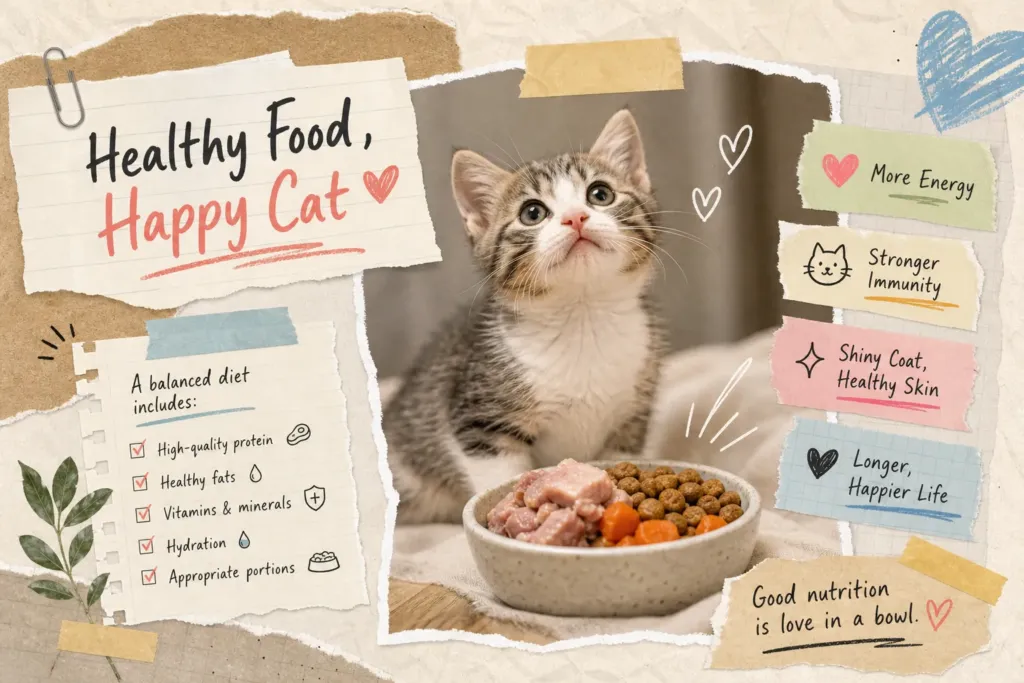
Balanced diet tips for cats start with one uncomfortable truth: most of those 40 bags of cat food in the pet store aisle are not created equal, even when every single one claims to be “complete and balanced.” Some say grain-free. Others say high-protein. A few have phrases like “ancestral diet” or “vet-recommended” printed in large font. If your first instinct is to grab the one with the nicest packaging and hope for the best, you’re not alone. Almost every new cat owner starts there.
Here’s the thing: what your cat eats from day one genuinely shapes their weight, energy, coat quality, and long-term organ health. A poor diet doesn’t usually announce itself immediately. It shows up months or years later as a heavier cat, a dull coat, or a kidney issue that could have been delayed with better nutrition earlier on. Getting it right from the start matters more than most new owners realize.
Certain breeds, especially British Shorthairs and Munchkin cats, come with nutritional quirks that make generic feeding advice less useful. Reputable catteries, including Kitty Palace Cattery, typically send kittens home with a starter diet plan covering brand, food type, and feeding schedule. That plan is your baseline, but it’s also just the beginning. This article covers the full picture: macronutrients, wet versus dry food, feeding schedules, breed-specific needs, and how to actually read a cat food label.
What “balanced” actually means in feline nutrition
Cats are obligate carnivores, and that changes everything
An obligate carnivore is an animal whose biology requires nutrients that only exist in animal tissue. Cats cannot synthesize taurine, arachidonic acid, or vitamin A on their own, they have to consume them through animal-based protein. This is different from dogs, who can convert some plant compounds into usable nutrients, and very different from humans, who have enormous dietary flexibility. A balanced diet for a cat looks nothing like a balanced plate for a person.
When a cat food label lists plant-based ingredients as primary components, that’s a problem. Cats have evolved as hunters, and their digestive systems reflect that. Their bodies are built to extract what they need from prey, not grains or starches. Keeping that in mind makes every other nutrition decision clearer.
The three macronutrients your cat actually needs
Protein is the foundation of every feline meal. AAFCO guidelines set a minimum of 26% crude protein on a dry-matter basis for adult cats and 30% for kittens. Veterinary nutritionists often recommend higher targets, around 40 to 55% of total calories from protein, to better support muscle, organ function, and coat health. Cats need significantly more dietary protein than most other mammals.
Fat is the primary energy source for cats, not carbohydrates. It also delivers fat-soluble vitamins and essential fatty acids, including omega-3s and omega-6s that support skin, coat, and heart health. The target range most often cited by veterinary nutritionists is 30 to 45% of calories from fat. Carbohydrates, on the other hand, are the macronutrient cats need least. They lack key digestive enzymes to process carbs efficiently, and AAFCO sets no required minimum for carbohydrates in cat food at all. A low-carb content is a feature, not a flaw.
Balanced diet tips: wet food vs. dry food
The real advantage wet food has for most cats
Wet food mirrors a cat’s natural prey diet more closely than any kibble can. It contains roughly 70 to 80% moisture, which directly supports kidney health and urinary tract function. Cats have a naturally low thirst drive, meaning they rarely compensate for dry food by drinking enough water. The result is chronically concentrated urine, which raises the risk of crystals and urinary disease over time.
For breeds like the British Shorthair, which is genetically prone to heart disease and urinary issues, high-moisture food isn’t just a nice-to-have. It’s a practical health measure. Wet food also tends to be lower in carbohydrates and higher in protein per calorie, which aligns better with what feline physiology actually needs.
When dry food has a place in your cat’s diet
Dry kibble is more calorie-dense, cheaper per serving, and easier to manage on a busy schedule. Some cats do well on a combination approach: wet food as the primary meal with a small, measured portion of dry kibble alongside it. The combination can work, but it requires intentional portioning on the dry food side.
Quality matters more than format in both cases. The first ingredient should be a named animal protein: chicken, salmon, turkey, beef. If the first ingredient is “meat meal,” corn, or a starch, keep looking. Free-feeding dry food is one of the most common causes of feline obesity because it’s easy to lose track of how much a cat actually eats across a day.
Building a feeding schedule that keeps your cat healthy
How often cats should eat
Kittens under six months need three to four small meals per day. Their fast growth rate demands consistent calorie intake, and their blood sugar stability benefits from more frequent feeding. By around six months, you can transition to two meals per day, spaced roughly 12 hours apart. This mirrors a more natural predator feeding rhythm and makes it much easier to monitor appetite, one of the earliest signals of a health issue.
Senior cats may need adjustments depending on weight trends, kidney function, or breed-specific health tendencies. The basic two-meals-a-day structure still works for most, but portion size and protein targets may shift as a cat ages and becomes less active.
Portion control and meal planning: the part most owners get wrong
The feeding guidelines on packaging are a starting point, not a prescription. Your cat’s actual portion depends on their weight, age, activity level, and body condition score. The practical way to assess body condition is straightforward: you should be able to feel your cat’s ribs without pressing hard, but not see them clearly from above. A visible waistline from a bird’s-eye view is a good sign. A cat that looks rectangular from above is carrying too much weight.
Even a small daily caloric excess adds up quickly. In a cat, just 10 extra calories per day translates to meaningful weight gain over the course of a year. Measured meals eliminate most of that guesswork and are one of the simplest balanced diet guidelines you can follow consistently.
What your breeder’s starter plan tells you
When you bring a kitten home from Kitty Palace Cattery, you’ll receive a diet plan specifying the brand, food type, and feeding schedule the kitten has already been on. This matters because abrupt food changes cause digestive upset in young kittens. Stick with that plan initially, then transition gradually over 7 to 10 days if you want to switch foods, mixing increasing amounts of the new food with the original.
Use that breeder-provided plan as your reliable baseline. It reflects how the kitten has been raised and gives you a stable starting point. From there, build your long-term feeding routine in consultation with your vet as the kitten grows into an adult cat.
Reading cat food labels without getting lost
What the ingredient list actually tells you
Ingredients are listed by weight before processing. A named animal protein as the first ingredient is a good sign. Watch for ingredient splitting: when manufacturers list multiple forms of the same ingredient, corn flour, corn gluten, ground corn, separately so each one appears lower on the list, even though their combined weight is actually high.
Avoid formulas where the first several ingredients are grains, starches, or unnamed “meat by-products.” These are the labels where the healthy eating tips on the front of the bag have little to do with what’s actually inside.
The guaranteed analysis panel explained
The guaranteed analysis panel shows minimum crude protein and fat percentages. When comparing wet and dry foods, account for moisture content by converting both to a dry-matter basis before comparing numbers. Wet food naturally shows lower percentages because of its high water content, but that doesn’t mean it’s lower in protein once moisture is removed from the equation.
Look for AAFCO nutritional adequacy statements on the packaging. “Complete and balanced” means the food meets established minimum nutrient profiles for the life stage listed. Taurine should either appear as an added nutrient or be present in sufficient amounts naturally from the protein source. It’s non-negotiable for cats.
A simple weekly routine worth building now
Structure your cat’s week around consistency
Cats are creatures of routine in the most practical sense. Feeding at the same times each day reduces anxiety, supports digestive regularity, and makes it far easier to notice when appetite drops, one of the earliest signs that something is off health-wise.
A straightforward daily structure for most adult cats looks like this: a wet food meal in the morning, a wet food meal in the evening, and a small measured dry kibble serving if you choose to include it. Fresh water stays available at all times, ideally in multiple locations and kept away from the food bowl, since cats prefer to drink from a source not adjacent to where they eat.
Rotate protein sources over time: chicken-based one week, fish-based the next, turkey-based after that. Variety prevents nutritional gaps and reduces the risk of a cat fixating on a single flavor to the point where they refuse anything else. Keep a simple feeding log for the first few months, tracking what your cat ate, how much, and any digestive changes. It makes vet conversations significantly more productive.
Final balanced diet tips: setting your cat up for a healthy life
These balanced diet tips won’t feel overwhelming once you see how the pieces connect. Protein-first nutrition from named animal sources, wet food as the foundation of the diet, consistent meal times, and breed-aware portion control cover most of the ground. For British Shorthairs, that means active weight management and heart-supportive nutrients from early on.
If you’re bringing home a kitten from Kitty Palace Cattery, your starter diet plan gives you a solid, breed-specific baseline right from day one. Use it, transition new foods gradually, and build from there with your vet’s input as your cat grows. The cattery’s breed pages are also a useful resource for ongoing prep guidance.
The moment your kitten walks through your door is the right moment to get this right. Start with protein-first food, keep moisture high, feed on a schedule, and watch portions, those four habits alone put you ahead of most new owners and give your cat the foundation for a long, healthy life.
FAQ
For cats, “balanced” means a diet that meets their obligate carnivore needs—providing animal-based protein and nutrients they cannot make themselves, such as taurine, arachidonic acid, and vitamin A. A balanced feline diet emphasizes adequate protein and fat while keeping carbohydrates low, because cats evolved to extract nutrients from prey rather than plant sources.
AAFCO sets minimums of 26% crude protein on a dry-matter basis for adult cats and 30% for kittens, but veterinary nutritionists often recommend higher targets—around 40 to 55% of total calories from protein—to support muscle, organ function, and coat health. Prioritize foods that list animal-based proteins near the top of the ingredient list.
Wet food more closely mirrors a cat’s natural prey and contains roughly 70–80% moisture, which supports kidney health and urinary tract function. Because cats have a low thirst drive and may not drink enough to compensate for dry food, wet food can help reduce chronically concentrated urine and the associated risk of crystals and urinary disease.
When a cat food lists plant-based ingredients as primary components, that’s a concern because cats require nutrients found in animal tissue. Grain-free labeling doesn’t guarantee appropriate protein or nutrient balance, so evaluate ingredient sources and ensure essential animal-derived nutrients are present.
Use the starter diet plan provided by reputable catteries such as Kitty Palace Cattery as your baseline—those plans typically include brand, food type, and feeding schedule. Treat that plan as a starting point and work with your veterinarian to adapt it as the kitten grows and to address any breed-specific needs.
Focus on the source and order of ingredients—animal-based proteins should appear near the top, and avoid foods that list mostly plant-based components as primary ingredients. Also check guaranteed analysis for crude protein and fat levels, and look for mention of essential nutrients like taurine, since cats cannot synthesize them on their own.