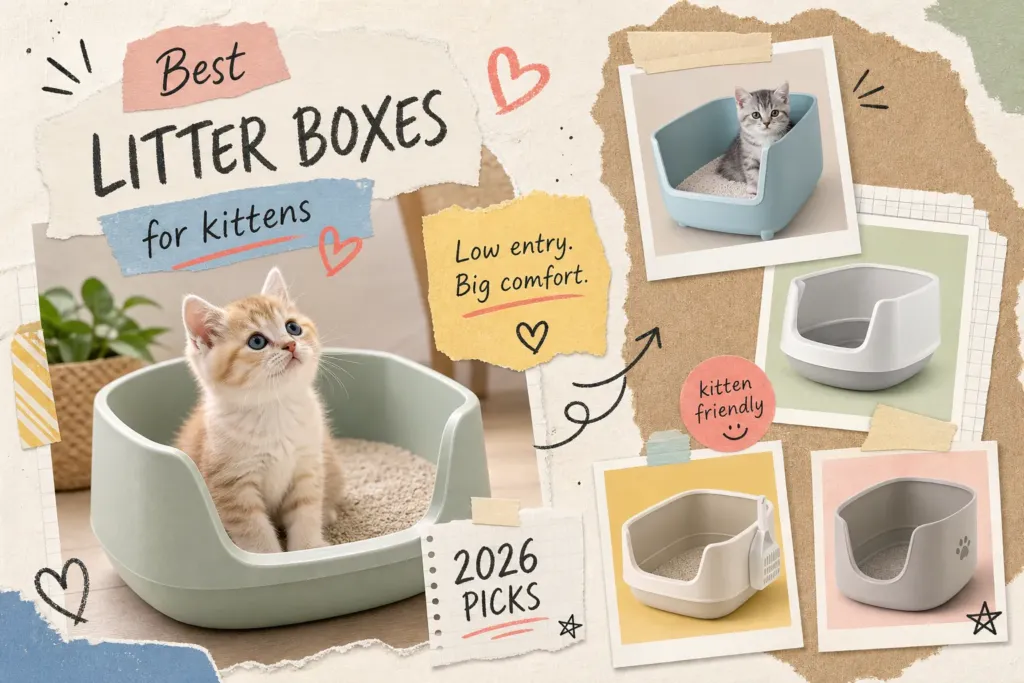
A new kitten coming home is exciting, and choosing the best litter box for kittens is one of the first purchases that determines whether litter training goes smoothly in week one or becomes a source of daily frustration for months. The wrong box, too tall, too deep, too confined, can stop a young kitten from even attempting to get inside, and that sets the whole training process back immediately.
Choosing a good kitten litter box is not just about picking the smallest one on the shelf. Entry height, floor space, box type, and even your kitten’s breed all factor into the decision. Breed-specific setup questions, like what floor dimensions a British Shorthair kitten actually needs versus a slim-bodied tabby, are exactly the kind of detail reputable catteries walk new owners through before pickup day. Getting it right from the start matters far more than most people expect.
By the end of this guide, you’ll know which features to prioritize and which box types to avoid in the early months. You’ll also learn how to match the box to your kitten’s breed and age, and which products are worth your money in 2026. There’s a short setup and training routine at the end that gets most kittens using the box reliably from day one.
What actually makes a litter box good for kittens
Adult-sized litter boxes fail young kittens for simple, physical reasons. The walls are too high, the floor space is overwhelming, and the entry point requires a jump or climb that a 7-week-old kitten simply cannot manage. The three things that matter most in any kitten litter pan are entry height, usable floor space, and how easy the box is to clean daily.
Entry height: the number that matters most
For kittens under 3 months old, the standard recommendation is an entry height of 2 to 3 inches. From 3 to 6 months, that range moves to 3 to 4 inches as the kitten grows stronger and more coordinated. A high lip on the front of the box does not teach the kitten to jump in, it teaches the kitten to eliminate somewhere else, and that habit forms fast.
Floor space and the turning room rule
The widely used sizing guideline is that the box should be about 1.5 times the kitten’s body length, giving enough room to enter, turn around, and position correctly. In practice, that means roughly 12 to 16 inches long for kittens under 3 months, and 18 to 22 inches long for kittens between 3 and 6 months. A small litter box for kittens that’s undersized causes elimination outside the box just as quickly as a high-sided one does. Floor footprint matters every bit as much as wall height.
Material and cleanability
Smooth-interior plastic is far preferable to textured or rough finishes. Smooth interiors are easier to wipe clean and are generally recommended over textured surfaces, which can hold odor and make daily maintenance harder. A box that’s quick to scoop is a box you’ll actually keep clean, and a clean box is the single biggest factor in whether a kitten reliably returns to it.
Which litter box types work for young kittens (and which to skip)
Not every box on the market is appropriate for kittens, and the sheer variety available can make a simple purchase feel complicated. The good news: simplicity wins at this stage, every time. Here’s a quick breakdown of what works and what to leave on the shelf.
Open, low-sided trays: the safest starting point
Open, low-entry trays are the clear recommendation from veterinary and shelter sources for kittens under 6 months. They offer full visibility so the kitten can see its surroundings, easy entry without climbing, and no confined airspace that traps odor and discourages use. There is no real competition here for kittens in the early months. Start with an open tray and you will eliminate most common litter training problems before they start.
Covered and hooded boxes: fine later, not ideal now
Covered boxes reduce airflow, limit the kitten’s exit options, and can feel confining when a young cat is still getting comfortable in a new home. Behavioral guidance broadly agrees that covered boxes are a reasonable choice for confident, older cats, especially in households where owners want to reduce visible litter scatter. For a kitten under 6 months, though, skip the hood entirely and revisit that option once the cat is reliably trained and comfortable in the space.
Self-cleaning boxes: skip them for now
Automatic litter boxes can startle kittens with unexpected noise or movement, and many models have entry specifications that small kittens cannot clear safely. The general guidance is to wait until a cat is fully grown, healthy, and reliably box-trained before introducing any automatic unit. Buying a self-cleaning box now and hoping a kitten adapts to it is a fast way to create a box-avoidance problem that takes weeks to undo.
Sizing the box to your kitten’s breed, age, and body type
Generic kitten litter box advice stops at age. Getting this right also requires thinking about breed and body type, which changes the sizing equation significantly.
Why breed matters as much as age
Stocky, broad-chested breeds like British Shorthairs carry more body mass at every stage of kittenhood than leaner breeds of the same age. A box that comfortably fits a slim 4-month-old can feel tight and awkward for a chunky British Shorthair of identical age, though it’s worth noting that breed size differences become more pronounced as kittens grow, so early upsizing is more about planning ahead than an immediate size gap. At Kitty Palace Cattery, this is exactly the kind of breed-specific guidance shared with new owners before a kitten comes home, because the difference between a correctly sized box and a marginally undersized one directly affects how quickly training clicks. If you’re adopting a stocky or large-breed kitten, always size toward the larger end of the recommended range from the start.
Under 3 months vs. 3–6 months: what to buy at each stage
For kittens under 3 months, target a shallow cat litter box roughly 12 to 16 inches long and 9 to 12 inches wide, with a front entry of 2 to 3 inches. At the 3-month mark, plan to upsize to a box in the 18-to-22-inch length range with a slightly higher but still accessible entry point. Buying one box and hoping it lasts through the full kittenhood period usually means undersizing during the key growth phase. Plan for two boxes rather than one, and the transition will be much smoother.
Best litter box for kittens: top picks across price points
These three options cover the realistic range of what’s available in 2026 for kitten-specific litter training. Each has a specific use case rather than being a generic recommendation. Prices and ratings reflect retailer listings at time of writing, confirm current pricing before purchasing.
Best litter box for kittens on a budget: Van Ness cat litter pan
The Van Ness pan is a commonly recommended budget option that checks every box for a very young kitten’s first few weeks at home. There are no features to complicate things: low entry, open top, smooth interior. Use it as your starter box with a kitten under 3 months and replace it without guilt once the kitten outgrows it. At this stage, function beats frills every time.
Best overall: Frisco high-sided cat litter box, extra large
Listed on Chewy and rated 4.6 out of 5 stars, this open-top box has high back and side walls that significantly reduce litter scatter while keeping the front entry low enough for kittens to step in comfortably. It’s a strong choice for kittens in the 3-to-6-month range and for larger-breed kittens that need the floor space and a grown-up box they won’t outgrow after a few weeks. The smooth interior cleans easily, and the dimensions give a growing British Shorthair or Scottish Fold plenty of room to maneuver. Check the Chewy product page for current pricing, as listings vary by size and configuration.
Best low-entry pick: KittyGoHere senior cat large litter box
Originally designed for senior cats with mobility limitations, the KittyGoHere Large measures 24 by 20 inches with a front entry of just 5 inches, among the lowest front-entry heights you’ll find in a commercially available litter box. At around $40.95 on Chewy (confirm current price before purchasing), it’s the strongest pick for British Shorthair, Munchkin, or other stocky-breed kittens that need wide floor space and easy-access entry from the very beginning. The size makes it a box that grows with the kitten rather than one to replace at the 3-month mark.
The right litter to use with a kitten box
A correctly sized box paired with the wrong litter still produces training problems. This part of the setup gets less attention than box selection, but it matters equally for kittens under 4 months.
Non-clumping litters: the safe choice under 4 months
Young kittens explore with their mouths, and that includes investigating litter. Non-clumping paper pellets and pine pellets are the safest choices for kittens under 3 to 4 months because they do not form a solid mass if swallowed. Clumping clay litter can expand inside a kitten’s digestive tract, which creates a real blockage risk in young kittens who are still in the exploratory chewing phase. Paper and pine pellets eliminate that risk while still providing effective odor control and absorption.
What to avoid and when you can switch
Avoid scented litters entirely: the fragrance deters box use in young cats and can irritate their respiratory systems. Silica crystal litters carry an ingestion risk for young kittens and are best avoided until the cat is much older. The recommendation from most shelter and veterinary sources is to wait until at least 4 months before introducing clumping litter, and potentially 4 to 6 months for kittens who still show interest in tasting or eating litter. When in doubt, stick with unscented paper or pine pellets longer rather than switching early.
How to set up the box and get your kitten using it from day one
Setup and placement matter as much as the box itself. A good box in the wrong location, or introduced at the wrong moment, still leads to training problems. Follow this routine and most kittens will be reliably using the box within a few days of coming home.
Where to place the box (and where not to)
Choose a quiet, low-traffic corner away from food and water bowls and well clear of loud appliances like washers, dryers, or furnaces. For multi-level homes, place at least one box on each floor. For kittens new to a home, confine them initially to one room so the box is always within easy reach. A kitten that cannot find the box in time will use the nearest available surface instead, and that habit forms quickly.
The 5-step training routine
- Show the kitten the box immediately when they arrive home, before anything else.
- Place them gently in the box after every meal, nap, and waking period, since those are the most common elimination windows.
- Watch for behavioral cues: sniffing along the floor, crouching, or circling are all signals to move the kitten to the box right away.
- Praise calmly after successful use. A quiet “good job” or a small treat is plenty. Overly excited reactions can startle young kittens and make them avoid the box.
- Scoop daily at minimum, and more often if you have multiple kittens. A dirty box is the most common reason a kitten stops using it.
Getting your kitten set up right from the start
The best litter box for kittens is not the most expensive one or the one with the most features. It’s the one that matches your kitten’s current size and stage: open, low-entry, smooth interior, and sized to the 1.5x body length rule. Pair that box with non-clumping paper or pine litter until at least 4 months, place it in a quiet and accessible corner, and scoop it daily. That combination solves most litter training challenges before they start.
Breed matters in the sizing equation, and that detail is easy to miss when you’re relying on generic advice. If you’re adopting from a cattery like Kitty Palace Cattery, it’s worth asking about the specific box setup they’ve been using with your kitten’s litter before pickup day. Breeders who specialize in British Shorthairs, Scottish Folds, Munchkins, and Scottish Straights understand how their kittens are built and what setup gives them the best start. Having the right box ready before the kitten arrives means one less thing to figure out on an already busy day.
Start simple, match the box to the kitten, and keep it clean. That’s really the whole formula.
FAQ
For kittens under 3 months, aim for a 2–3 inch entry height; from 3 to 6 months, 3–4 inches is appropriate. A high front lip forces young kittens to avoid the box and forms bad elimination habits quickly.
Use a box about 1.5 times the kitten’s body length so the kitten can enter, turn, and position comfortably. In practice that’s roughly 12–16 inches long for kittens under 3 months and 18–22 inches for kittens 3–6 months old.
Covered or hooded boxes are not ideal for kittens under 6 months because they reduce airflow, limit exit options, and can feel confining. Open, low-sided trays are the recommended starting point until the kitten is older and fully comfortable in the home.
Smooth-interior plastic with a low, open design is best because it wipes and scoops more easily than textured surfaces. A box that’s quick to clean encourages daily maintenance, and a consistently clean box is the single biggest factor in reliable use.
Match the box footprint to the kitten’s body type: stockier breeds like British Shorthair need more floor space than slim-bodied kittens such as many tabby types. If in doubt, follow the 1.5× body length rule and ask your breeder or cattery for breed-specific guidance before purchase.
No — many adult boxes have walls that are too high and floors that are too large for young kittens, creating physical barriers that discourage use. Starting with an appropriately sized, low-entry tray prevents training setbacks and eliminates common early problems.
Place an open, low-entry tray with smooth interior in a quiet, accessible spot and show the kitten where it is when you bring them home. Put the kitten in the box after meals and naps, scoop daily to keep it clean, and keep placement consistent; most kittens learn reliably with this brief routine.