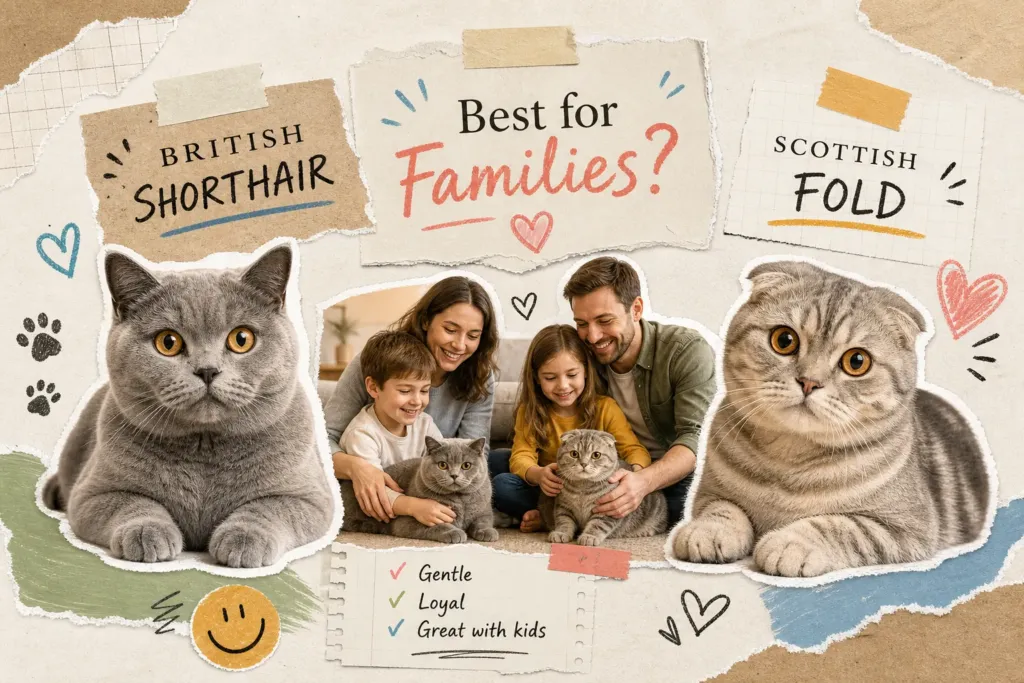
If you’re weighing which cat breed is better for families, British Shorthair or Scottish Fold, you’ve probably already spent hours scrolling through photos and reading breed-chart summaries that all say roughly the same thing. The British Shorthair looks like a plush stuffed animal with a personality to match. The Scottish Fold has those irresistible round eyes and folded ears that stop people mid-scroll. Both seem calm, both seem gorgeous, and every photo shows them draped over a couch like they’ve never had a bad day. So which one actually belongs in your home?
That’s the real question, and it’s one families ask at Kitty Palace Cattery, our TICA-registered cattery in New Jersey, more than almost any other. Once they understand the two breeds more deeply, past the photos and the breed-chart adjectives, they often land on a clear answer surprisingly fast. This guide covers temperament, health, lifestyle fit, cost, and the ethical layer that every informed family deserves to understand before choosing.
Which cat breed is better for families, British Shorthair or Scottish Fold: temperament compared
The British Shorthair’s quiet confidence at home
The British Shorthair doesn’t need to be the center of attention, and that’s genuinely one of its best qualities for family life. It’s calm, gently independent, and affectionate on its own terms. This is a cat that will follow you to the kitchen, settle near you on the couch, and be perfectly content without demanding constant interaction. It prefers sitting beside people rather than on laps, and most British Shorthairs actively dislike being carried around.
What makes this breed exceptional for busy households is that its temperament doesn’t spike with the energy in the room. Whether it’s school drop-off chaos, a dog barking, or kids arguing over the remote, the British Shorthair takes it all in stride. It’s a steady, grounded presence that doesn’t need you to manage its emotions.
How Scottish Fold personality shows up day-to-day
Scottish Folds are genuinely sweet cats. They tend to be curious, gentle, and more tolerant of lap time than British Shorthairs. Where a British Shorthair chooses proximity, a Fold often chooses contact. They enjoy company, follow their people around the house, and settle comfortably into calm routines.
The important word there is “calm.” Scottish Folds are less assertive and more sensitive than British Shorthairs. They pick up on tension and disruption in the household more readily, which matters both for their happiness and,, for their physical comfort. A Fold thrives in a gentle, low-drama environment. A British Shorthair thrives almost anywhere.
How each breed handles kids, noise, and other family pets
British Shorthair with children and other pets
The British Shorthair’s patience with children is real, but it has limits. This breed does best with school-age kids who understand that a cat isn’t a stuffed animal. Toddlers who grab, chase, or squeal tend to make British Shorthairs retreat rather than react, which is actually a good safety profile. Breed guides consistently note that they withdraw rather than lash out when stressed; they leave first.
With other pets, British Shorthairs adapt well. They’re friendly with cat-tolerant dogs and other cats, provided introductions are handled gradually. They tend to assert themselves as the confident, dominant animal in the household without aggression, which helps establish a stable social order. For multi-pet homes, that’s a meaningful feature.
Scottish Fold with children and multi-pet homes
Scottish Folds generally do well with children who are taught gentle handling. They’re more interactive and affectionate than British Shorthairs, which makes them wonderful companions for older kids who want an engaged, lap-friendly cat. With toddlers, though, this breed is less naturally suited: they’re more sensitive to rough handling and can become stressed in high-stimulation environments.
There’s also a physical consideration that parents need to know upfront. Because of the joint disease associated with the breed, covered fully in the next section, Scottish Folds can experience pain during active play or when picked up and handled roughly. A child who doesn’t know the difference between a comfortable cat and a stressed one can unintentionally cause real harm. This isn’t a dealbreaker for families with the right household dynamic, but it changes the conversation significantly.
Grooming, energy levels, and which breed fits your lifestyle
Daily grooming and coat care for each breed
Neither breed is high-maintenance on the grooming front. British Shorthairs have a dense double coat that needs brushing once or twice a week, with more frequent sessions during seasonal shedding. A short-haired Scottish Fold requires roughly the same level of coat care. For a busy family, both breeds are manageable without professional grooming appointments.
Scottish Folds are reported to have higher rates of ear problems, so regular ear checks and cleaning should be a consistent part of their routine care. British Shorthairs have standard upright ears with no added risk in that area.
Activity levels and how each breed fits different home environments
Both breeds are moderately active, neither is likely to demand entertainment at 2 a.m. or pace restlessly through a quiet apartment. British Shorthairs are happy with 15 to 20 minutes of daily play and adapt comfortably to apartments, suburban homes, or larger houses as long as they have a steady indoor routine. Give them play, company, and quality food, and they’re content.
Scottish Folds need low-impact play specifically to protect their joints. High-energy households with energetic kids and rough-and-tumble play sessions can unintentionally cause discomfort or stress in a Fold. If your household is calm and intentional about how you interact with a pet, a Fold can thrive. If your home runs at full volume most of the day, the British Shorthair is the cleaner fit.
How Kitty Palace Cattery serves Northeast families ready to bring a kitten home
At Kitty Palace Cattery, we breed both British Shorthairs and Scottish Folds under TICA registration from our New Jersey cattery. Whichever direction this article has pointed your family, the next step is the same: connect with a breeder who will answer your questions directly, show you health documentation, and support you through the entire process, not just the sale.
Every kitten we place goes home with age-appropriate vaccinations, a health certificate, and a one-year limited health warranty covering congenital and hereditary conditions. We serve families across New York, New Jersey, Pennsylvania, Connecticut, Maryland, and Massachusetts, with delivery available for families who can’t make the trip to us. Our reservation and waiting list system means you can plan ahead and choose the right kitten on the right timeline, rather than settling for whatever happens to be available from an unvetted source.
So which cat breed is better for families, British Shorthair or Scottish Fold?
When deciding which cat breed is better for families, British Shorthair or Scottish Fold, consider your household energy, your children’s ages and temperaments, and your honest comfort level with the health and ethical complexity that comes with the Fold. Either way, the path forward is the same: find a TICA-registered breeder who is transparent about health, accountable through a formal contract, and genuinely invested in the wellbeing of both the kitten and your family. If you’re in the Northeast and ready to take that next step, reach out to Kitty Palace Cattery.
Frequently Asked Questions
Both breeds can be excellent family cats, but they suit different household styles. British Shorthairs are calm, independent, and handle noisy, busy homes well, while Scottish Folds are more affectionate and contact-seeking but need a gentler, low-drama environment. Many families at Kitty Palace Cattery find their choice becomes clear once they match breed temperament to their daily routine.
Yes — British Shorthairs are patient with children but do best with school-age kids who understand how to handle a cat. They tend to withdraw rather than react when stressed, so they’re safer around kids who won’t treat them like a toy. Toddlers who grab or chase can make a British Shorthair retreat.
Scottish Folds are generally less suited to households with toddlers because they’re more sensitive to rough handling and high stimulation. They do very well with older children who are taught gentle handling and enjoy lap time and close contact. A calm, low-drama home helps a Fold thrive.
British Shorthairs adapt well to other pets, often asserting a confident but nonaggressive role that helps establish household social order. Scottish Folds usually enjoy company and can do well with other animals, but they’re more sensitive and benefit from gradual, gentle introductions. In both cases, slow introductions improve long-term harmony.
British Shorthairs show quiet confidence: they’re independent, prefer sitting beside people rather than on laps, and dislike being carried. Scottish Folds are sweeter and more contact-oriented, following people around and enjoying lap time, but they’re also more sensitive to household tension. Those differences determine which breed fits a given family dynamic best.
Pick a British Shorthair if your household is busy, noisy, or includes active kids or dogs — they tolerate chaos and don’t demand constant attention. Choose a Scottish Fold if your family can provide a calm, gentle environment and you want a more affectionate, lap-friendly companion.
Both breeds adapt well to apartment living given their moderate activity levels. British Shorthairs are particularly well-suited: they’re self-contained, undemanding, and comfortable with a consistent indoor routine. Scottish Folds can also do well in apartments, provided the environment is calm and handling is gentle enough to protect their joints.
The British Shorthair is widely regarded as one of the most family-friendly cat breeds available. Its even temperament holds steady in noisy, busy households, it adapts well to other pets, and it handles children’s energy without becoming stressed or reactive. For families with toddlers, multiple kids, or other animals, it’s one of the most reliably stable choices.